
The journey of a thousand miles begins with a single step.“
– Lao Tzu
When I was in the fourth grade, I was obsessed with the Guinness Book of World Records. For kids growing up before the internet, the Guinness book wasn’t really a reference book. It was a book of possibilities. Every page contained proof that ordinary people could become extraordinary simply by deciding to do something that no one else had ever done. There were the predictable records for the fastest, strongest, and tallest. There were also records for the longest fingernails, the heaviest twins, largest collection of belly-button lint, or number of spoons you could balance on your face. But there were also records that seemed wonderfully democratic. Anyone, at least in theory, could become a world record holder. You just had to pick the right record.
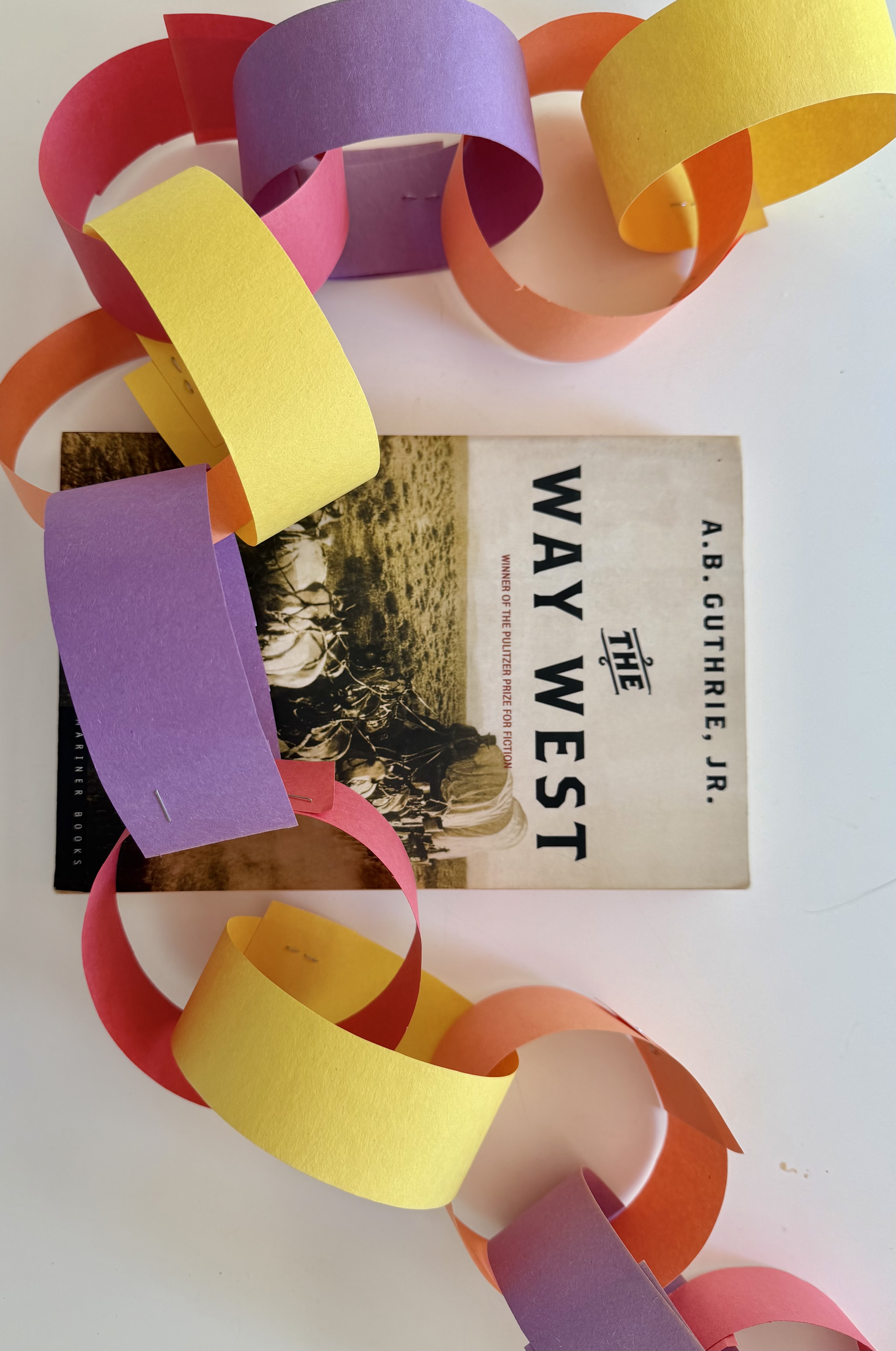
And it was that thought that led me to flip through those pages for hours until I found mine: the world’s longest paper chain.
To ten-year-old me, this was perfect. Unlike the world’s fastest runner or the tallest person, this one didn’t require unusual genetics or years of training. It required construction paper, glue, scissors, and determination. As far as I was concerned, those all seemed readily available.
Everything should be made as simple as possible, but not simpler.”
– Albert Einstein
I can’t recall now exactly how long the existing record was, but I do remember thinking it could absolutely be broken. You see, ten-year-old me was also pretty good at math. So instead of wondering whether we could break the record, I treated it like a word problem.
I timed myself making ten paper-chain links and connecting them together. Then I measured how long those ten links were. Once I had those data points, the rest was simple. If (a) one person could make X paper links every hour, (b) I recruited Y neighborhood kids, and (c) we all stayed awake for twenty-four straight hours, then (d) we would produce a paper chain longer than the existing world record.
The math worked perfectly.
Looking back, it seems obvious that point (c) was going to be the problem. Ten-year-old me, however, wasn’t worried about whether staying awake for twenty-four hours was realistic. I was worried about staffing. Without realizing it, I had created my first project plan.
Many hands make light work.”
– John Heywood
The recruiting campaign began. I went door to door convincing neighborhood kids that together we were about to become world record holders. Somehow, they bought in. Even more remarkably, so did my parents. They could have smiled politely and explained that maybe we should start with something smaller. Instead, they purchased what felt like an endless supply of construction paper and transformed our garage into mission control.
Soon there were kids everywhere, cutting strips, applying glue, looping one link through another, then another, then another. The pile of colored paper slowly transformed into something tangible. Every new link felt like progress toward history.
Then we encountered our first logistical problem. Where exactly do you put the world’s longest paper chain?
Fortunately, my dad had a solution. He installed measuring posts down the block so we could stretch the chain between them and calculate our progress. He never questioned the premise. He simply assumed that if we were attempting a world record, we’d need a reliable measurement system. (I’ve written about my dad a couple of times before, and this story deserves to be added to his growing list of extraordinary acts of parenting.)
Success is where preparation and opportunity meet.”
– Bobby Unser
One of my favorite subplots from Paper-Chain-Making Day concerned my realization that we’d eventually need to validate our achievement. I became so confident we were going to succeed that I called the local newspaper, the Arizona Republic. Mind you, I called them not after we’d broken the record. Not even when we were getting close. Before. Apparently, ten-year-old-me believed newspapers appreciated advance notice for impending world records.
The details are fuzzy now, but I remember looking up the newspaper’s phone number in the phone book and giving them a call. I’m not sure who answered, but I gave a very detailed explanation of our ambitious undertaking. To their credit, someone actually listened. Somewhere in the newsroom, someone apparently decided that a gang of fourth graders attempting to build the world’s longest paper chain was worth keeping an eye on. They say some stories write themselves. This wasn’t one of them.
Everybody has a plan until they get punched in the mouth.”
– Mike Tyson
In the end, the math had been flawless. Reality was less cooperative.
Around dinnertime, cracks began to appear in my workforce. One kid had to go home because dinner was ready. Another had family plans. Someone else got tired. Another simply lost interest. One by one, my labor force evaporated. The calculations that had looked so elegant on paper hadn’t included parents. Or boredom. Or pizza. Or the simple reality that asking fourth graders to stay awake for twenty-four consecutive hours is, in retrospect, a terrible management strategy.
I don’t remember how close we got. I don’t remember how long the existing record actually was. I don’t remember what eventually happened to the enormous paper chain we’d created.
I do, however, remember the phone ringing sometime after we had called it quits. The reporter was calling back. I had to tell him we hadn’t broken the record after all. To be honest, I don’t remember whether he sounded disappointed, whether I only imagined he did, or whether I was simply hearing my own disappointment reflected back at me. Either way, our world-record attempt quietly became just another neighborhood story.
(Incidentally, the current Guinness World Record for the longest paper chain created by a team in twenty-four hours is 54.33 miles, set by Paul D. Camp Community College in Virginia in 2005. I remain convinced we were only a few hundred neighborhood kids short.)
The trail is the thing, not the end of the trail.”
– Louis L’Amour
My paper chain may not have gotten very far, but it turns out distance wasn’t really the point. I found the same lesson inside A. B. Guthrie Jr.’s The Way West, winner of the Pulitzer Prize for Fiction in 1950, and is often considered the definitive literary novel of the Oregon Trail, capturing westward expansion not as myth, but as a difficult, messy, deeply human undertaking. Set in the 1840s, it follows a wagon train leaving Independence, Missouri, bound for the Oregon Territory. At the center of the story is Dick Summers, an experienced mountain man hired to guide dozens of families across nearly two thousand miles of wilderness. They leave with maps, supplies, livestock, carefully planned routes, and enough optimism to believe they can cross an entire continent.
At first, the journey seems almost mathematical. They know how many miles they hope to cover each day. They know where the rivers are. They know where they’ll camp. On paper, everything works. Then the West has its say.
Rivers become impassable. Storms destroy carefully laid plans. Tempers flare. Leaders are questioned. Friendships fracture. People become exhausted. Guthrie’s novel slowly reveals that the greatest obstacle to reaching Oregon isn’t the mountains or the rivers. It’s the travelers themselves. Every ambitious undertaking eventually stops being a logistical problem and starts becoming a human one. The maps don’t become wrong. They simply become incomplete because they can’t account for fear, stubbornness, fatigue, ego, or hope.
The Way West has aged remarkably well. Guthrie doesn’t romanticize the frontier the way many Westerns do. Instead, he treats westward expansion as a profoundly human enterprise, filled with courage, selfishness, resilience, pettiness, generosity, and doubt. The novel is rich in atmosphere and remarkably thoughtful about leadership and group dynamics, which is why it has remained a classic of the genre for more than seventy-five years. If it has a weakness, it’s that modern readers may find its deliberate pace a bit demanding. Like the wagon train itself, the novel doesn’t hurry. There are stretches where the journey feels repetitive, and Guthrie occasionally spends more time describing landscapes than developing individual characters. But that slow rhythm is also part of its power. By the time you reach Oregon, you feel as though you’ve crossed the continent alongside the travelers, one exhausting mile at a time.
By the time I reached the last page, I couldn’t help but think about my paper chain. My calculations weren’t wrong. If twenty neighborhood kids each produced a certain number of links every hour, we probably would have broken the record. What my spreadsheet failed to account for was exactly what Guthrie understood. Human beings get hungry. They get tired. They lose patience. They decide they’d rather be somewhere else.
The Oregon Trail had rivers and mountain passes. My expedition had pizza. Different obstacles, perhaps, but exactly the same lesson.
Great things are done by a series of small things brought together.”
– Vincent van Gogh
Guthrie understood something that applies just as well to wagon trains as paper chains. Every extraordinary accomplishment is really just an accumulation of ordinary actions repeated far more times than anyone thinks possible.
Writing a book is mostly writing one page after another. Running a marathon is mostly taking one more step. Learning a language is mostly showing up for one more lesson. Building the world’s longest paper chain is mostly making one more link. The pioneers in The Way West didn’t reach Oregon through one heroic act. They reached it one campsite, one river crossing, one difficult decision, and one exhausting day at a time.
It’s remarkable how often this lesson reappears. We eat an elephant one bite at a time. We climb mountains one step at a time. Cathedrals are built one stone at a time. James Clear encourages us to become one percent better every day. Jerry Seinfeld famously kept a calendar where the goal wasn’t to write something brilliant each day, only to “not break the chain.” Even writing Pulitzer Schmulitzer has turned out to be little more than reading one chapter, then another, then another. Different metaphors. Same truth.
The secret isn’t usually brilliance. It’s endurance.
The credit belongs to the man who is actually in the arena.”
– Teddy Roosevelt
For years, I thought this story was about failing to break a world record. Now I think it was really about getting the chance to try.
My parents never laughed. They bought the construction paper. They surrendered the garage. My dad installed measuring posts down the street because if his ten-year-old son was going to chase a world record, he’d need a proper way to measure it. For one glorious Saturday, they treated an impossible dream as though it were completely reasonable. Looking back, that may have been the greatest gift of all.
The pioneers in The Way West eventually discover that crossing the American frontier isn’t a triumph of maps. It’s a triumph of perseverance. The map can tell you where you’re going, but it can’t tell you whether you’ll keep walking when things get difficult. The same was true of my paper chain. Breaking the record was never going to depend on paper, glue, or multiplication. It was always going to depend on people.
The funny thing is, after all these years, I still think the math worked. We were simply solving for the wrong variable.
We never built the world’s longest paper chain. But for one unforgettable day, an entire neighborhood believed we just might. Looking back, I don’t remember how long the paper chain became. I only remember how long we believed it could become.
 PULITZER SCHMULITZER!