#62 – Sometimes Things Work and Sometimes They Don’t: My Summer Vacation vs. “A Fable” by William Faulkner (1955)

Def: Serendipity: 1. an aptitude for making desirable discoveries by accident; 2. the occurrence and development of events by chance in a happy or beneficial way. See also: you can’t make this sh*t up.

Things can happen by accident or chance. Incredible things. Things that cannot be manufactured or created by will. I know this to be true, but it’s astounding that, at my age, I’m still surprised that these things happen and that they often work out OK. Or at least, much better than they should have. Sometimes by “work out” I mean “I didn’t die” (see, e.g., when I, at age 17, was left in Tijuana with $5 and no ride and decided my best option was to hitchhike to San Diego). But most of the time it is less about avoiding a tragic outcome, and more about stumbling across amazing moments that I would (and should) have never expected to happen. Serendipity. And that’s exactly what happened when we went to Europe this summer.

To set the stage, it is important to know that we give our older kids a lot of say in where we vacation. Possibly too much. Like when the kids chose…wait for it….Pennsylvania! for spring break, we were skeptical, but it worked out. Between Hershey Park, Gettysburg, and the cheesesteaks, we had a great time. One year wiser, this year we limited the options for our summer destination to Europe, and solicited suggestions.

Where did we end up? Start with my daughter Lily, who just turned 12 and whose favorite book in the whole wide world is The Fault in Our Stars, which, if you haven’t read it, really is the best (non-Pulitzer prize winning) book in the whole wide world. And in TFIOS (tweens love acronyms), a pivotal story arch has the two cancer-stricken teenage protagonists visit Amsterdam. Ergo, we have Lily’s choice and stop #1, and promptly purchased four tickets to Amsterdam. My son Sam is 13 and a legitimate World War II history buff. And he knows his stuff. We once met a WWII vet at a museum and Sam correctly answered every obscure question the guy asked about the war. So, we had our next stop, and promptly purchased four train tickets to Berlin. (As an aside, Sam’s other top travel ideas at the moment are (a) Iceland to see the Aurora Borealis and (b) Burning Man. Places Sam Takes Me could be my new blog.)

On the plane to Amsterdam I opened up Donna Tartt’s The Goldfinch, winner of the 2014 Pulitzer Prize, and read the first sentence: “While I was still in Amsterdam, I dreamed about my mother for the first time in years.” While not itself serendipitous, it was certainly eerily coincidental, and foreshadowed the serendipity to follow. Because unless you live under a rock or really really really hate sports, then you have probably already figured out that our European adventure was about to collide with the World Cup.

I am by no means a die-hard soccer fan but I love the World Cup because the World Cup does one thing better than any other event that human beings organize –it focuses the attention of the world on one place at one moment. From the moment Brazil beat Croatia in the first match, a substantial portion of the living population of the Earth had its feelings altered simultaneously by the actions of 22 men chasing a ball around a field in Brazil. Only the Olympics brings people together like this, and hey, all due respect to the Olympics, but is it ever not the same thing.

And this World Cup pretty much had everything on the field and off. It started with an insane group stage full of upsets and ended with the coronation of Germany and the potential start of a dynasty. And along the way it had Robin van Persie’s header against Spain; Guillermo Ochoa blanking Brazil; Costa Rica leaving a trail of established European powers in its wake; James Rodrigues and the Giant Bug; the Netherlands’ equalizer against Mexico in the 88th minute; Tim Howard’s 16 saves and the series of nervous breakdowns that was US-Belgium; and Germany scoring four goals in six minutes against the most celebrated nation in soccer history, a team that hadn’t lost a competitive match on home soil since 1975. But I digress.

What will be really memorable about this year’s Cup, at least for me, is that it unfolded serendipitously to overlap perfectly with our kids very non-soccer focused vacation plans.

2014-07-09 21.36.22

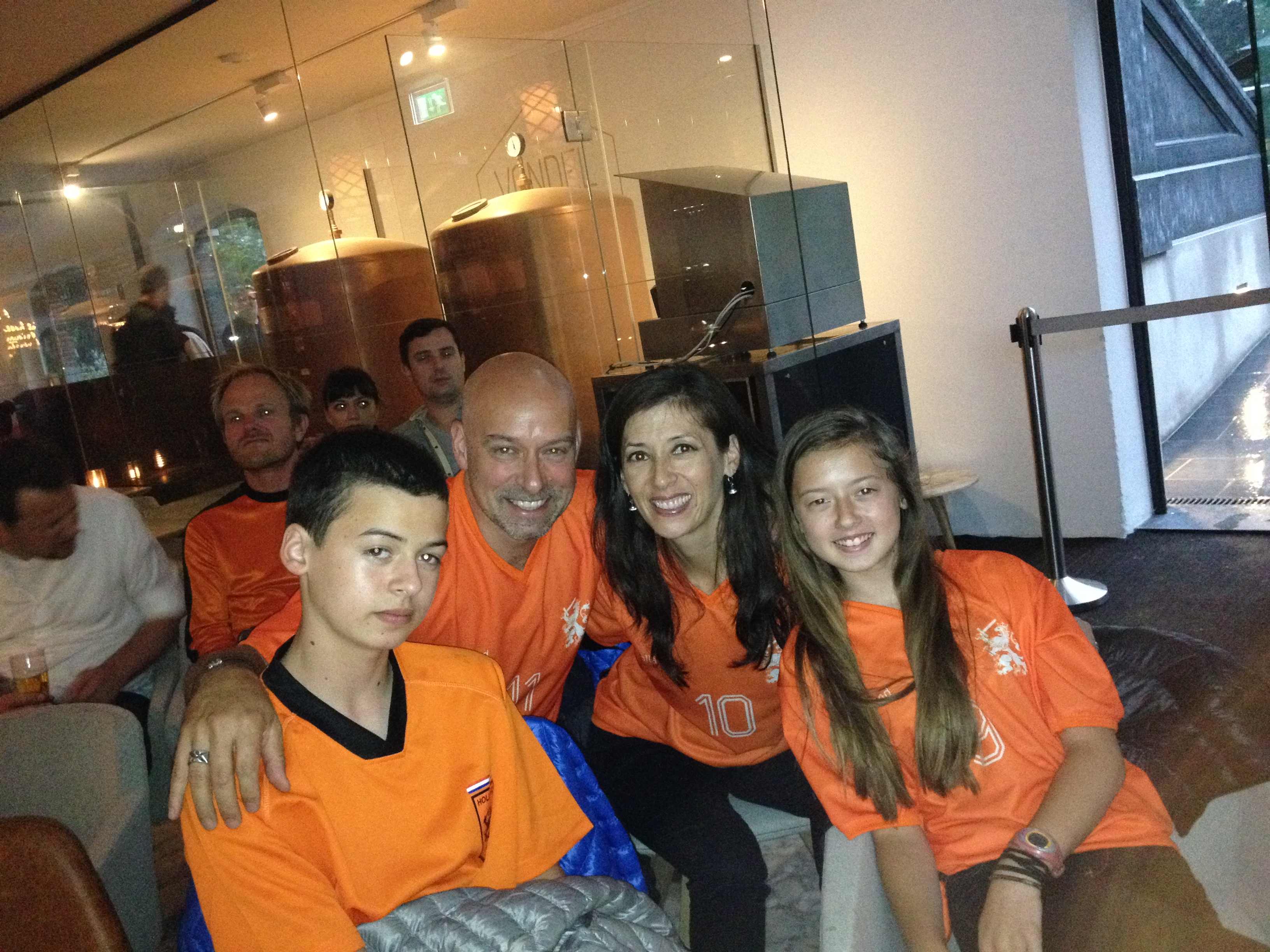
We landed in Amsterdam with enough time to get our bearings, check in to our hotel, purchase bright orange Robben, van Persie and Sneijder jerseys and find ourselves a spot in a bar near the Vondelpark to watch the Netherlands-Argentina match. The teams played to a stalemate and, truth be told, it wasn’t even an exciting stalemate. Argentina won in a shoot out, so we bid adieu to the Dutch who left us with so many lasting memories from this World Cup like…, um, well… Arjen Robben falling down.

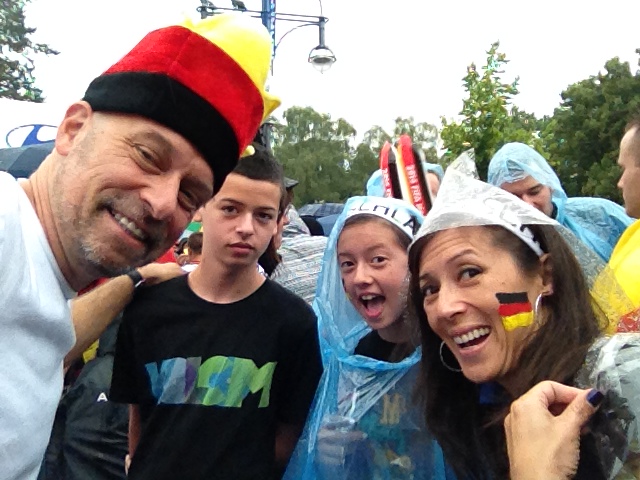
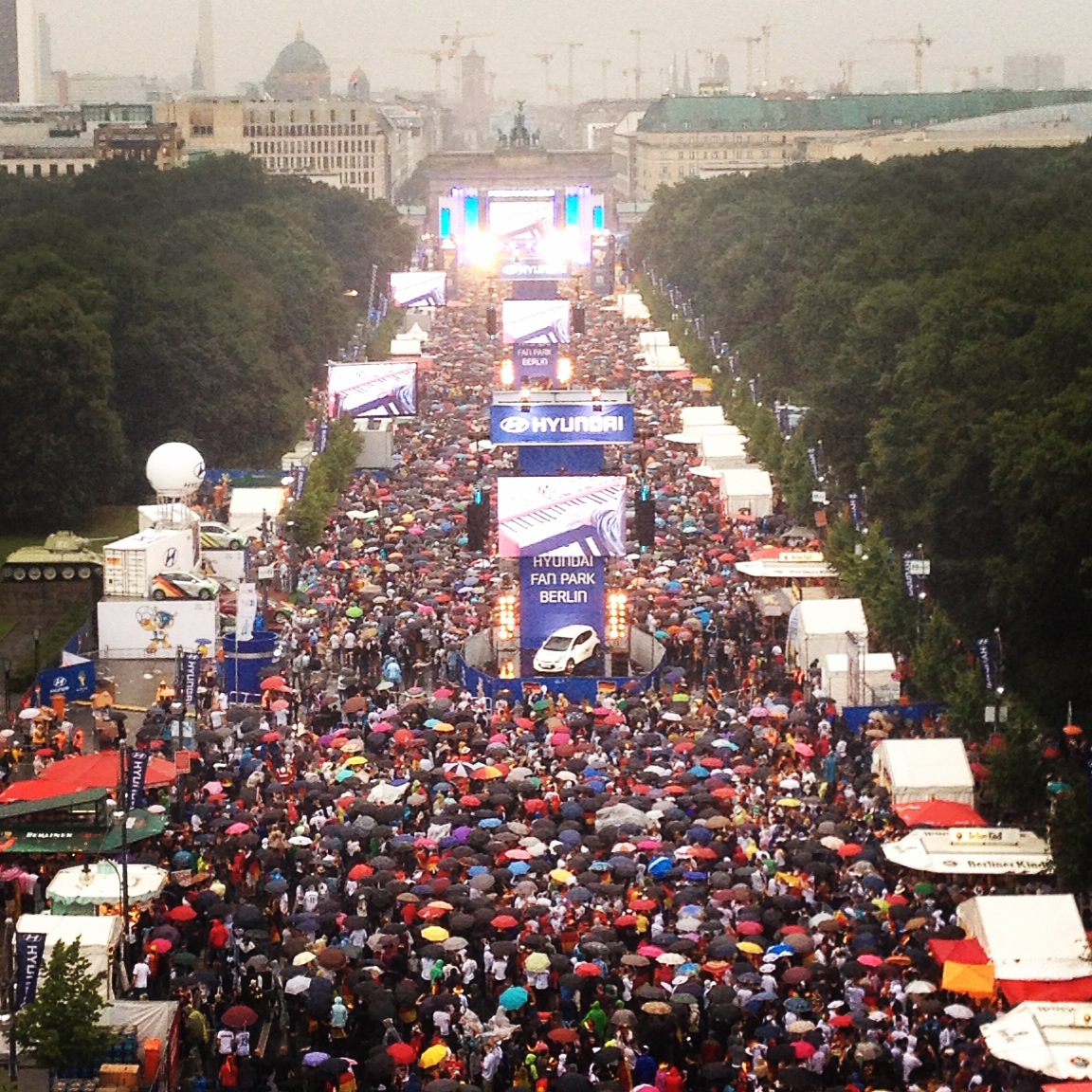
But we weren’t that upset. Our love of the Dutch was fleeting because, serendipitously, Germany let loose a historic and unanticipated 7-1 drubbing on Brazil in the other semi-final and, by chance, our itinerary had us landing in Berlin the day of the finals. So once again, we had just enough time to get our bearings, buy some appropriately allegiant clothing (this time the last of the German hats and flags in the stores), and make our way to the Brandenburg gate to watch the World Cup finals on the big screens with 100,000 of our closest German friends who were armed with a seemingly unending supply of beer and sausage.

2014-07-13 18.52.18

We all know how the story ends. Germany were crowned world champions for the fourth time thanks to a stunning extra-time winner from super sub Mario Gotze in the 113th minute. We hugged our drunk German brethren. We loudly sang German soccer songs without knowing a single word other than “Deutchland, Deutchland.” We drank giant beers. And we ruined our kids. Because now they want to know where we will celebrate the World Cup championship four years from now and I have to tell them that you can’t re-create what happened because it happened entirely by chance. It was serendipity. It was magical. And sometimes things just work out because working out feels awesome.

My 200,000 closest German friends as seen from the Ferris Wheel.
My 100,000 closest German friends as seen from the Ferris Wheel.

But sometimes it doesn’t, which brings me to William Faulkner’s A Fable. The plot itself is actually pretty straightforward: a French battalion in WWI lay down their arms and refuse to fight at the behest of a Christ-like corporal. Chaos ensues as the military powers-that-be realize that if all the soldiers realize peace is as simple as everybody agreeing to stop fighting, then what’s the point of being a power-that-be. The story chronicles the elaborate efforts of the French, British and American powers-that-be to investigate and cover up this absurdity, and to punish those responsible for daring to stop a war.

Faulkner, without a doubt, is a literary great and one of only two authors with two novels on the Pulitzer list. And evidence of his genius is abundant but the problem is it’s hidden amidst pages and pages of rambling paragraphs and speeches and descriptions that are circular and repetitive and overly-flowery to the point of being masturbatory. Moreover, as with James Cozzens’ Guard of Honor, most of the characters are seldom referred to by name, and there is a liberal use of pronouns with ambiguous antecedents, so it’s easy to lose track of who’s who and what they’re doing at any given moment. I love a dense and rambling novel as much as the next guy, but when you combine that with repetitive and opaque writing, the results are a far more challenging read than seems necessary.

It was painstaking to finish this one, but I was hoping that there would be that Faulkner pay-off where you just love the end of the book, where he brings everything together in a way that blows your mind. I was hoping it would all work out in the end. But sometimes it doesn’t. Faulkner was a brilliant writer, but by the time he wrote this, his fifteenth novel, he was less in need of talent than of an editor. This was not magical, and certainly not something that happened by chance. He manufactured this book, belaboring the language, writing intentionally and deliberately, and it did not work out OK. Except maybe for the whole winning the Pulitzer thing. Which, although good for him, didn’t help him rank any higher than last on my list with this novel.

P.S. If I was in need of any more serendipity on this trip I found it at the very last stop. After Berlin we headed to Prague and by chance, on our way home, in the Prague airport, there was a piano with a sign inviting people to play. And by chance, we had a few minutes to spare, and Lily embraced the opportunity, playing “Colors of the Wind” from the movie Pocahontas.

We weren’t home more than a week when, by chance, the following video appeared in my Facebook feed.

It turns out that the pianos have been placed around the city streets, public spaces and train stations as part of an unusual art project aimed at getting people together away from their typical routine. By chance the one piano that we came across was the exact same piano in the viral video. Serendipity? The occurrence and development of events by chance in a happy or beneficial way? Absolutely. It was one last magical moment that we never could have imagined. At least until the next one.

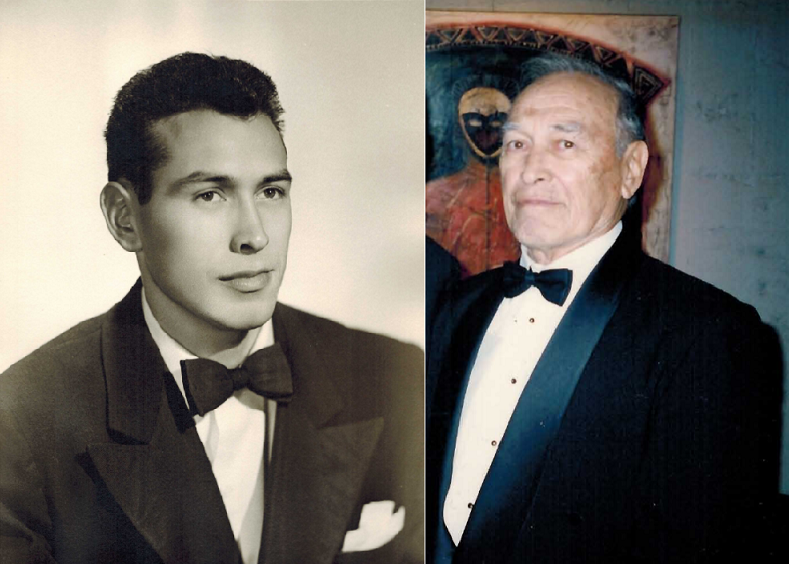
Thanks for everything, Dad. Especially listening to AC/DC.

Image

[NOTE: The Pulitzer Schmulitzer! countdown is taking a pause to honor a man who was better than me in many ways. OK, all ways.]

Joe Horton, my dad, passed away early Saturday morning in his sleep. It was expected and it was peaceful and it was painless and I was there. In other words, he died in the easiest way possible for everyone else, which was certainly consistent with the rest of his life. (If you want to know why he’s a “Horton” and I’m an “Orta,” buy me a drink and I’ll tell you the story. I promise it will be worth your while.)

A little bit about my dad. He was selfless. Certainly more selfless than I am, albeit a low bar. I’m sure part of this had to do with the fact that he grew up poor in Los Angeles during the Depression, which is like being really super über poor during any other time during the last century. He once told me a story about how he and his twin brother Sam cried one Christmas morning when they didn’t get a new bicycle they were expecting. His father, my grandfather, went out and sold the one piece of jewelry he owned of any value, his watch, and bought the bicycle. My dad never stopped feeling bad about that, and never asked for much after that. I, on the other hand, once pouted because I had to share a birthday cake on my birthday. I was 35, and the other person on my cake was my 1-year-old daughter. Selflessness counter: +1 to Joe; -1 to John.

But it wasn’t just that he didn’t need at lot. It was that he also gave a lot. My mother died when I was 12 and my brother was 10. A single father, he got us to school, doctor appointments, sports practices, piano lessons, play dates and birthday parties, all the while somehow feeding us and working full-time. But it was more than his ability to complete parental mechanics. On top of the driving/cleaning/cooking/everything-else-kids-need, he always made time to pay attention to us whenever we asked.

For example, when I was 12 or 13, I loved music and felt that certain songs were SO BRILLIANT that I needed to share these wise words with my dad. So nearly every day, I would make him come to my room to listen to Zeppelin, Hendrix, Floyd, the Stones, Bowie, Queen, or whatever else I happened to think was SO BRILLIANT at that very second. And he would. He’d stop what he was doing, come and stand in the doorway of my room, nodding his head to the beat. He’d stay until the end of the song, say “that’s great,” and go back to whatever task was at hand (which in all likelihood was something for my brother or me). Knowing his musical tastes now, and knowing how hard it is to get everything done in a day, I’m pretty sure he didn’t love the songs I played for him, and I’m positive he didn’t have the time to stop what he was doing to listen to them. And yet, I remember hearing him, on Sunday mornings in particular, while making French toast, singing AC/DC’s “Dirty Deeds (Done Dirt Cheap).” I can’t even make French toast. Selflessness counter: +1 to Joe.

It wasn’t just selflessness that he bested me at. He was also nicer, braver, and more handsome. He fought in a war. Listening to his stories about going out in LA in the mid-1940s, I’m pretty sure he was also a better dancer. And I’m absolutely sure he was a better athlete. Despite throwing me endless grounders and tight spirals, there was no way I could match his natural ability. My dad played football for UCLA under Harry “Red” Saunders. I regularly smoked cigarettes while playing rec basketball in high school. Like during the games. Another +1 to Joe.

Although playing football was his passion, my dad was a true fan of all sports so even though I never excelled at sports, I do excel at watching sports on TV. He let me, at 7-years-old, stay up to watch Gar Heard in the famous triple OT Suns-Celtics game in the NBA finals. We watched Nadia Comanici get a perfect 10 at the Montreal Olympics. We witnessed the Immaculate Reception, Reggie Jackson hit three home runs in three swings in the ’77 World Series, Leon Spinks upset Ali for the heavyweight crown, Bird’s Indiana State v. Magic’s Michigan State NCAA Championship Game, the Miracle on Ice, Borg-McEnroe, The Catch and the last two Triple Crown winners Seattle Slew and Affirmed. I’d give Joe a point for this, but allowing me to watch this much television, mostly past my bedtime, was questionable parenting.

As kids are prone to do, I grew up, moved to San Francisco, became a lawyer and started a family. We spoke less, not because anything came between us, but because life is busy. Then, a few years ago, he was diagnosed with colon cancer.

He battled the cancer – and battled it well – for a long time. True to form, he didn’t talk about it much, didn’t ask for much, choosing to battle it on his own. But cancer plays the long con and last summer, I got a call in the middle of the night from my brother. “Dad’s not doing well. You should come home.” I told him I was in London. “Am I going to make it?” “Not sure,” was his response.

So I got on the first flight I could get the next day and flew from London to San Francisco, took a cab home, unpacked and repacked (there isn’t a ton of overlap in summer UK and summer Phoenix wardrobes), went back to the airport and flew to Phoenix, the entire time wondering if I was going to make it on time and trying to figure out the last conversation we had and whether I told him I loved him. I needed to tell him what a great dad he was. When I arrived in Phoenix, I grabbed my rental car and drove straight to the hospital, raced up to his room and found….

…him sitting in a chair watching the Diamondbacks game and having lunch. “What the fuck?” That may have either been thought or spoken but in either case my brother gave me the “dude-sorry-but-seriously-he-was-on-his-death-bed-last-night” look. It wasn’t his fault. Turns out the cancer had shut down one of his kidneys and was wreaking havoc on the other. The doctors said that despite his recovery from the brink, the end was near and sent us home with hospice and a hospital bed.

Now I had the chance to give something back to him: I could be with him at the end. I flew my wife and kids in to say goodbye. We told stories and went through photo albums and laughed a lot (most significantly about my apparently very poor grades in Religious Studies, which my kids discovered in reading my old report cards that my dad had saved). At the end of the weekend, my wife and the kids said goodbye and headed back home. I stayed to wait for the end. Selflessness counter: +1 to John.

But it turns out the end wasn’t near. After about a week of watching my dad watch the Diamondbacks and eat lunch, I finally had to address the elephant in the room. “Dad,” I said. “I don’t think you’re going to die anytime soon.” “How long is this going to take do you think?” he asked. “I have no idea. How do you feel?” “I feel pretty good.” I said, “Pops, I love you, but I need to get back home. Call me if you think you’re dying and I’ll come back.” Selflessness counter: -1 to John

But THAT call never came. Instead, I got a call that they kicked him out of hospice, which is like getting kicked out of the Hotel California. And we took advantage of it. We met in San Luis Obispo for a weekend. He threw himself an 86th birthday party, and we went to it. My daughter Lily and I met him in LA when he went to his UCLA football reunion in November. My son Sam and I flew to Phoenix over MLK weekend. Six weeks ago my dad went to Barcelona because he had never been. I’m not kidding. +1 to Joe.

But the doctors had said that at some point he would begin to feel bad. And eventually they were right. About a week after coming back from Barcelona he went to the hospital and the doctors told him that the cancer had spread. It was a matter of weeks, not months.

So for the last five weeks I’ve been flying back and forth to Phoenix on the weekends and we did what we’ve always done best: watch sports. I rooted for the Warriors and he rooted for the Clippers (he won). I rooted for the Diamondbacks and he rooted for the Dodgers (I won). We watched Seung-yul Noh win the Zurich Classic, J.B. Holmes win the Wells Fargo, and Brendan Todd win the Byron Nelson. We even watched old guys play tennis on the ATP Champions Tour.

But by far the most fun the last few weeks has been watching California Chrome win the Kentucky Derby and the Preakness. My dad loved this horse. He loved him because he cost $8,000. He loved him because his owners were first time horse owners and called themselves Dumb Ass Partners. He loved him because his 77-year-old trainer had never had a horse in the Kentucky Derby. And he loved him most of all because he was from California, and a California horse hadn’t won the Derby since 1962.

Thursday night I got a call from my brother that was very similar to the one I received 10 months before when I was in London. “You need to come home.” So I took the first flight home in the morning, again wondering if I had told my dad I loved him when I left the weekend before.

My brother had warned me that he really wasn’t responding, but when I arrived early the next morning, he recognized me immediately. We hugged and I quickly told him that I loved him and that he was a great father. He told me I was a great son. I told him he was a better dad than I was a son and thanked him for listening to all the songs I made him listen to.

Then I asked, “Dad, do you remember the AC/DC song you used to sing when making French toast?” And without missing a beat, he busted into his best Bon Scott imitation and started singing the chorus: “Dirty deeds and they’re done dirt cheap.” “Yes!” I said, and together we sang a few verses. +1 to Joe.

It turned out to be his final point. When our singing stopped, he closed his eyes and fell asleep. That was really the last actual conversation we had. By the end of day, I’m not sure he recognized me anymore and he passed that night.

And if I was looking for some sort of sign, which I wasn’t, I was given one by 97.9 KUPD, the classic rock station that existed when I was a boy and continues to this day. On my way to the airport as I left Phoenix, they played, back to back, “Hey Joe” by Jimi Hendrix and “Don’t Fear the Reaper” by Blue Oyster Cult. The only thing weirder would have been if they’d played “Stairway to Heaven” next, and although tempted, I didn’t wait for the commercial break to end and gave the keys back to Thrifty Rental Cars. I had a year to say goodbye to the most selfless man I’ll ever know, and I think I did it well. And if you’re still keeping score (and I am, but remember I’m not that selfless), I’ll take this as my final +1.

Saying goodbye was a dirty deed, but it was done dirt cheap. So don’t fear the reaper, Joe. Climb the stairway to heaven. And if California Chrome wins the Belmont Stakes, I’ll know you made it.

#63 – Nostalgia Bites: Why KFC Is Way Better Than Guard of Honor (1949)

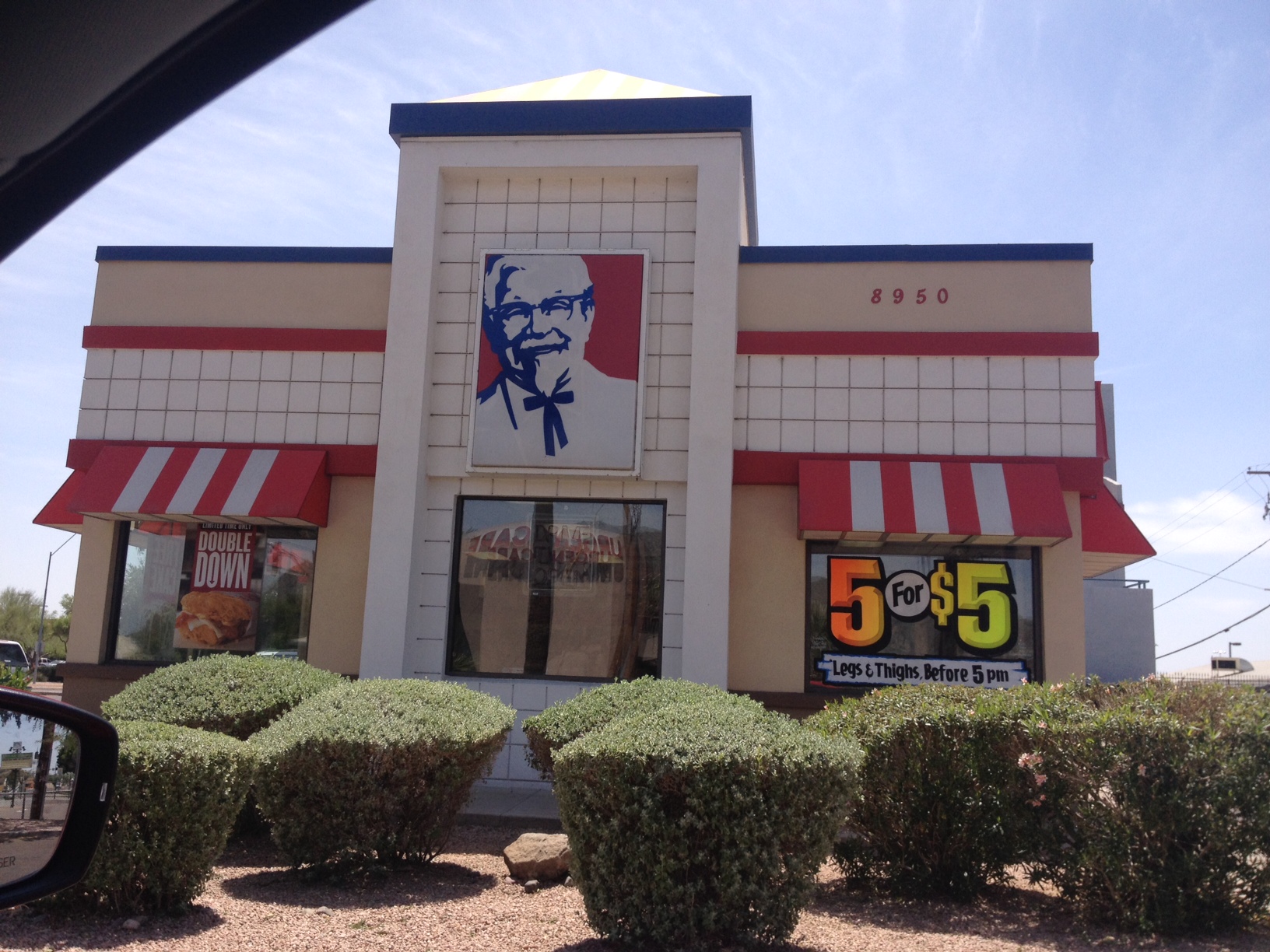
Nostalgia is a funny by-product of age. From time to time and more and more often as I get older, something will unexpectedly remind me of things – mostly nice things – from the past. Sometimes it’s a KFC. Image

I was in my hometown of Phoenix this past weekend and happened to go past this KFC, continued driving for a block or two, made a U-turn, pulled into the parking lot and shot this picture. Why? Nostalgia, of course. And not nostalgia for KFC in general – although I’ve been secretly craving the new Double Down and don’t understand why the twitterverse isn’t up in arms that it’s back for a limited time only – but nostalgia for this KFC in particular because when I was fifteen-ish, I spent a lot of time inside this KFC. Why? A girl, of course.

Nostalgia is fuzzier than memories and the details now elude me. Her name was Cathy although I can’t remember if it started with a “C” or a “K.” I for sure have no idea what her last name was. She could drive and I couldn’t, so she was older than me but not by much. I can’t remember how we met either. She was poor and didn’t go to my high school. We didn’t have any friends in common. I don’t recall ever meeting her parents or whether they were married or divorced. But she worked at the KFC so maybe I went in one day and ordered a three-piece meal, original recipe not extra crispy, and we hit it off. It doesn’t matter.

Whatever the impetus, for a year (or maybe it was just a summer) back in the ‘80s, we were inseparable although the particulars of what we did are as unclear as the details of how we met. She had a boyfriend who was senior at her high school, so we never dated although I’m sure we made out once or twice. I vaguely remember listening to a lot of Billy Squier and clearly remember sitting on the roof of my dad’s 1967 Buick late one summer night looking for shooting stars.  I know I loved that moment and I wish I had a recording of the conversation.

As with most relationships at that age, we drifted apart as high school rolled on. I think she dropped out and had her own apartment by the time she was 17. The last time I saw her was at her wedding when I was 19 or 20. I remember Italian food, getting to dance with her briefly and her looking very happy. I never saw her again.

Until I drove by the KFC the other day, I hadn’t really thought about Cathy (or Kathy) in over 20 years. Nonetheless, dipping my toe in the ’80s end of the pool was a happy trip down memory lane to visit fifteen year old me. One of the mixed blessings of being fifteen is the conviction that nothing like this, all evidence to the contrary notwithstanding, has every happened to anyone before. The passage of time may have changed my perspective, but at least in this case looking back was all good.

Unfortunately, I can’t say the same for Guard of Honor by James Cozzens, the Pulitzer Prize winner from 1949.  When I originally went to Amazon to buy this book, it was out of print. I was more than a little puzzled as to how a once-critically-acclaimed novel, if not a popular one, could fall so out of disfavor that it wasn’t even worth printing. Then I read it.

If you’re a person that likes to skip to the chase, there were about 10 pages in this 600-plus page book that I didn’t hate. And I was probably in an Ambien haze when I read those. Skip Chasers (or Chase Skippers?) can stop reading.

For those looking for a little more snarkiness, I’m glad you’re still with me. The entire story is set on a fictional United States Army base in central Florida and takes place over a three-day period during World War II. There are no chapters. Instead, the novel is divided into three large sections aptly named: Thursday, Friday, and Saturday. Judging from the memorandums that appear throughout the story, the days in question are September 2nd, 3rd, and 4th of 1943. It doesn’t matter.

Despite its significant size, only three things happen in this book. The first involves a white officer punching an African-American pilot. This sets up event two, where other African-American pilots protest the use of segregated officer clubs, and the leadership debates appropriate action. Finally, during day three, there is a mass training exercise in which seven equipment-laden soldiers accidentally parachute into a lake, sink to the bottom, and drown. The last incident, incidentally, has nothing to do with anything, and the total pages used to actually tell those stories was less than ten percent of the book.

The other ninety percent was mindless description of life on the base using military terms that I was completely unfamiliar with and inane dialogue (e.g., “’Oh, Judge!’ General Beal said. ‘That boy is a honey! You can believe me. Because we have a few more like him we’re going to win the war.'”). But maybe the most annoying thing about the novel was Cozzens’ decision to further confuse the reader by introducing at least twenty characters, none of which could be considered the main character, and all of which were referred to only by rank and last name which made it virtually impossible to keep them straight. I spent most of this book trying to figure out which character committed suicide, an event that took place in the first forty pages. I never did figure it out.

I’m almost done. But if you need any more, it’s not only boring, it is hard to read. Cozzens’ writing is filled with rhetorical questions, double negatives, disorientating descriptions, esoteric words, and equivocal pronouns. I had to constantly re-read sentences to ascertain, for example, what part of which abstract idea the pronoun “this” referred to. I found myself constantly drifting, which required me to re-read paragraphs, if not pages.

In short, I’ve got two words for Guard of Honor. Pain. Ful. Sometimes, nostalgia gives you the warm fuzzies. But other times, you look back and realize you simply made a mistake and cringe a little. This book falls in the latter category.

Ok, now I’m done.

#64 – On Bedside Notebooks, Ambien and Not Being An Asshole

I’m a terrible sleeper. Truly horrible. And I’m not talking about the occasional night when life is stressing you out because you’re thinking about what you need to do tomorrow or crap you screwed up at work or stupid things you said to your fill in the blank (spouse, boss, mom, dentist, Uber driver, etc). Those nights I get. But with me, it is not an occasional night; it is almost every night.

Is my life that stressful? Nope. But my brain has decided (I speak of my brain in the third person when it’s being unreasonable) that even if I don’t have anything to actually stress about it, it will make things up. And the best part is it will make up things that will NEVER EVER happen such as what if I get the ebola virus or what if one of my kids gets attacked by a shark. I’ll wonder if rattlesnakes can swim. I’ll think about Kayser Sose or if I know anyone who might be either (a) in the Illuminati or (b) legitimately crazy and mad at me that they’d go on a Left Eye burn the house down rampage.

But it’s not just totally improbable stressful thoughts that keep me up. I’ll also ruminate over fantasy football line ups, whether the “In the Air Tonight”/Miami Vice intro was the best intro to a television series ever (it was), and if I could sit cross-legged on the floor and try and stand up without using my hands or the walls or any furniture because I read that if you can then you’re six times less likely to die prematurely than if you can’t. In fact, last night I woke up because I had the idea that I should write a blog post about waking up so outlined the idea in the notebook by my bed.

Why is there a notebook by my bed you ask? Well, in the old days (prior to 2013) I would have just dealt with my lack of sleep and been, well, tired. But now we are inundated with articles on how insomnia makes you fat or sleep cures depression. We learn about exercising for better sleep and napping for success, and an array of new sleep devices and products, including dozens of sleep-monitoring smartphone apps, alarm clocks that won’t wake you during REM stages, sleep-inducing chocolates, candles that crackle like fireplaces, technologically enhanced sleep masks that “switch off your mind,” fitness bracelets that give you a sleep score and a $12,000 sleep-enhancing mattress containing soothing seaweed and coconut husks.

So after being bombarded by this, I decided this sleeping thing might be worthwhile and went to my doctor to see if he could help. This particular doc is a little on the homeopathic bent, so after hearing about my sleeping issues he suggested counting sheep (seriously), spraying my bed with lavender, taking melatonin or valerian root (or both), practicing meditation (I’m the worst meditator that ever lived but that is a story for another day), or flexing and unflexing every muscle in my body starting with my feet. None of this worked. (As an aside, he also suggested drinking less coffee and alcohol. Not a huge fan.)

But he did suggest two things that weren’t totally useless. First, he suggested keeping a notebook by the side of my bed so that if I woke up thinking about ideas for work or things I needed to do the next day (such as write a blog post on not sleeping), I could simply write them down. Brilliant. Totally helped. Second, he said that if none of the other things worked (including said notebook), it was important that I at least sleep well every third day so I should take an Ambien. Also brilliant.

But the uber brilliant part of this advice that he failed to mention was the magic that would happen when I would take an Ambien, have a brilliant thought, fight through the haze and write this pearl of wisdom my bedside notebook. Saul Bellow, author of Pulitzer winner Humbolt’s Gift (1976) once said: “You never have to change anything you got up in the middle of the night to write.” Saul clearly never took Ambien. Or read my notebook.

Exhibit A: The other night I had an epiphany in my dream that was so life-changing that I emerged from my fake Ambien sleep to jot it down and fell immediately back asleep. I woke up to a note that says:

“It isn’t the dinner that is important. It is the cook.”

And I think what I meant there was that life is not about the accomplishment and is really much more about the company you keep while getting there.  Which sort of makes sense.

Except that it also sort of also implies that I think life is less about reaching your goals and more about sitting around while other people make you food. Which is kind of shitty.  Ambien-me is kind of an asshole, I think. Never make Ambien-me a chicken pot pie.  He’s sort of a dick.  Sorry about that.

And speaking of assholes, the last position on the Pulitzer Schmulitzer! countdown doesn’t go to a book or author. Nope, last place is reserved for the Pulitzer Prize Board itself for the 7 times in the last 65 years that they didn’t pick a winner. That’s right. Seven times they looked at every book published in a given year and passed. Total assholes.

To be fair, if you look at the list, you’ll notice that six of these seven non-decisions were made prior to 1977 so although I was aware of these non-choices, I believed that this was an anomaly of times gone by that we wouldn’t see again. Until 2012 happened.  That year, three books were nominated by the committee: Swamplandia! by Karen Russell, Train Dreams, by Denis Johnson, and The Pale King, by David Foster Wallace. But instead of picking one, for the first time in more than three decades, the Pulitzer Board refused to give an award for fiction.

Admittedly, I didn’t read any of them (because I was too busy reading all the other Pulitzer winners), but they must have been pretty good, right?!?! According to the Washington Post, these three books were “unanimous” selections of the committee. But even if they weren’t the “best” books of the year, the statement made by refusing to award any of the books forwarded to them by the committee is that no novel published in 2011 was up to the standard set by the Pulitzer Prize in over 60 years of arbitrary award giving. And that’s bullshit.

The winner of the Pulitzer Prize, or any other award, is not the “best novel ever” or even necessarily the “best novel of the year.” There were no doubt a hundrednovels published in 2011 that were good enough to win the Pulitzer. In fact, NPR said that 2011 was “a terrific year for fiction.” And those NPR guys are really smart. Or at least they sound really smart on my radio. In addition to the ones officially nominated, they could have chosen Jesmyn Ward’s Salvage the Bones, the winner of the National Book Award, Kevin Wilson’s beautifully weird The Family Fang, or The Art of Fielding by Chad Harbach (the last two I did actually read).

To not pick one, for whatever reason, is not only arrogant, but also dumb. It is arrogant because you’re saying that there was not a single book published that year worthy of the award. Even if true (which it isn’t), you should still pick. The Downtown Athletic Club doesn’t decide to cancel the Heisman Trophy Award when the best they can do is Gino Torretta or Eric Crouch. And it’s dumb because this isn’t something that you need to even be right about. Look at the Oscars. They picked Driving Miss Daisy, Out of Africa, Forrest Gump, The English Patient, and Titanic as the Best Picture winners. Horrible movies, but no one cares. Imagine, however, if they’d come out on stage and told the audience that they decided they weren’t going to pick a winner that year. There would be blood.

There is an old Latin saying that I’ve been using recently (that is a whole other story), “provehito in altum,” which is an idiom that means both “reach for the heights” and “launch forth into the deep.” I love it because it means two possibly opposite things, but both are equally awesome. Not picking a Pulitzer Prize winner is like the opposite of provehito in altum. Totally un-provehito in altumy.

So my message to you Pulitzer Prize Board people is don’t ever do that again. Make a decision. And don’t be an asshole.

Welcome to Pulitzer Schmulitzer! The exclamation point is mandatory.

Pultizer Schmultizer! owes its existence, like many babies born today, to a chance encounter, a few quirky personality traits, timing and the internet. Here’s the short version.

A few years ago, I was in a used bookstore with my wife Gigi meandering aimlessly and trying to decide what book to read next when I noticed fairly weathered piece of paper taped to the wall. Upon closer inspection, it turned out to be a list of all the Pulitzer Prize winners for fiction since 1948. I had read a few of the more recent ones such as The Amazing Adventures of Kavalier & Clay (2001), Empire Falls (2003) and The Road (2007). Liked all three. And I’d read some of the older ones as well like The Old Man and the Sea (1953); To Kill a Mockingbird (1961); A Confederacy of Dunces (1981); and The Color Purple (1983). Liked those as well.

In hindsight, my interaction with the ratty paper list should have ended right there. Maybe with a small “huh” followed by “where should we eat?” But I was little intrigued. And, more importantly, I was more than a little lazy and thought that this could be a fine way to speed up the what-book-should-I-read-now process that, truth be told, can give me a headache if it requires me to spend too much time in second hand bookstores. So I declared there and then and out loud in that shitty little used bookstore that I would read the entire list. Gigi rolled her eyes. And I’m pretty sure guffawed.

You see, she knew what was coming. She knew that I would make that type of impulsive (and by definition not well thought out) declaration and then be stubborn enough to follow through with it despite the fact that it makes absolutely no sense. There were 56 books on this list at the time, with a new one added every year. I have a job, three kids, and other things to do like watch television. Best case, I’m reading a book a month. Best case. So on a whim, I just signed myself up for a multi-year project for no good reason and therefore, obviously, I was going to do it. Even if it was stupid. Maybe even because it was stupid. So I picked up Phillip Roth’s American Pastoral and the journey began.

Which is where the internet came in. I’d always wanted to write a blog because I love writing and I’m a little narcissistic but I’m also not that creative so could never figure out anything to write about. But about a year in to my Pulitzer reading, I realized two things: (a) my aging memory was already forgetting the books that I had read; and (b) although some books were great, some of the Pulitzer winners were total shit and people needed to know that. And so, an idea was born.

Here at Pulitzer Schmulitzer! we will rank the Pulitzer winners from worst to first. It’s a format that checks all the boxes. I get a structure for my blog (people love lists and I love the symmetry of creating a list from a list), I get a forum to document the books I have read so I don’t forget them, and I get to publicly rank these novels for the good of humanity. Everybody wins.

My original plan was to write as I read which would seem a logical process if you’re concerned about memory loss. But life is busy and as I mentioned I’m a little lazy so the whole thing stalled in a morass of lethargy and indifference. That was reality. What I have told myself, though, was that I actually needed to read the books first to provide the proper perspective for the rankings. And I’m convincing so that has become my truth. What seemed like laziness was really just veteran savvy. But now, the books have been read. And although I’m a firm believer that you should never force yourself to finish something important because of an artificially imposed deadline, if this is going to happen it needs to happen now.

So here we are on the cusp. How does it work? Well, the first rule of Pulitzer Schmultizer! is there are no rules with Pulitzer Schmulitzer! I couldn’t be less qualified to rank these novels. But that isn’t the point. We may not have qualifications. Or talent. But we do have a frayed list, impulsiveness, laziness, stubbornness, a lack of creativity, a pinch of narcissism, the internet and a series of questionable decisions that have brought us here. And I, for one, think that’s a very good thing. So without further ado, lets rock and roll.

Or at least talk about some books.