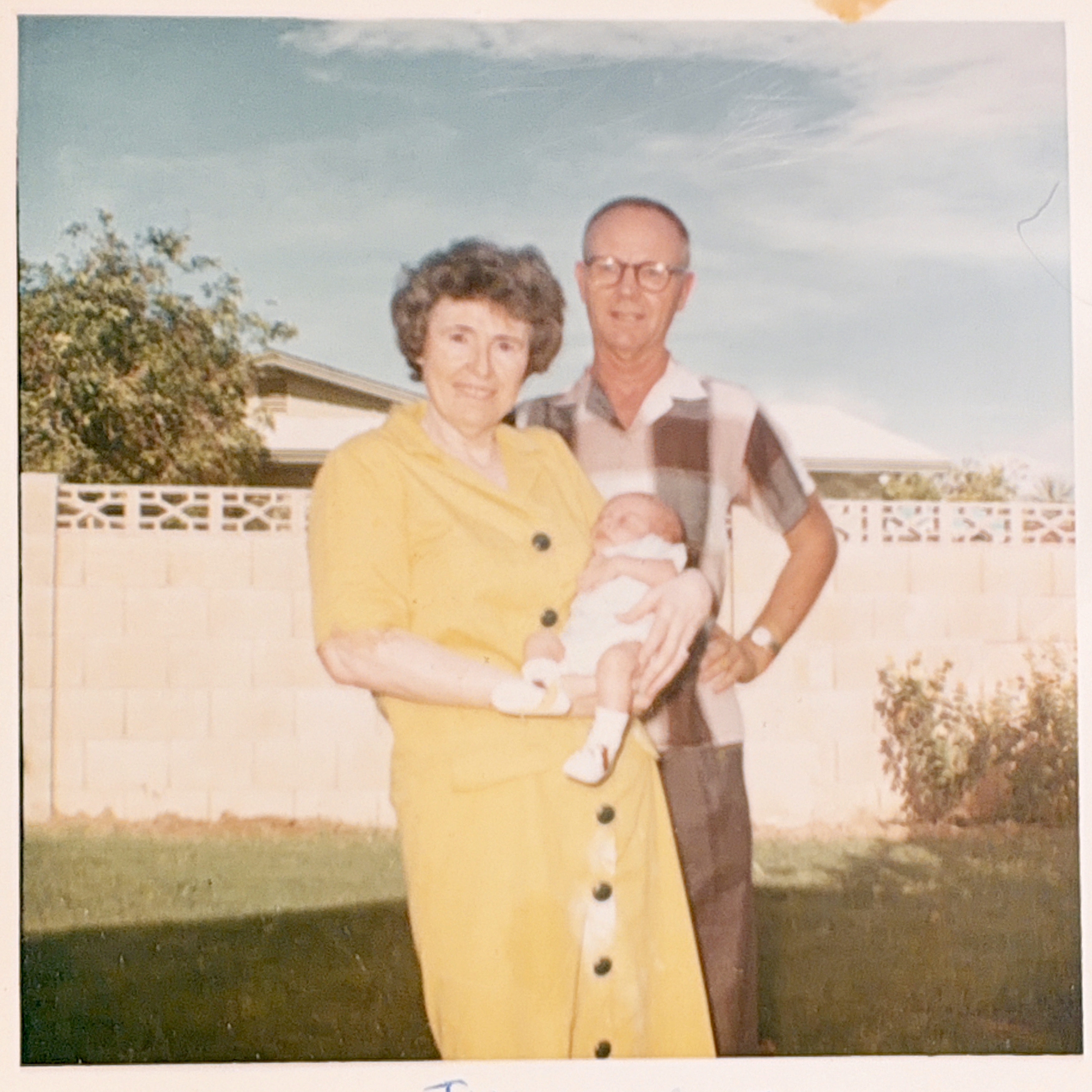
“Communication breakdown / It’s always the same”
– Led Zeppelin (1968)
I have a story I call “Bad News From Huntsville.”
It happened sometime in the late 1990s. How do I know it was the late 1990s? First, the story involves an email, which didn’t really arrive in my life until around 1995. Second, it happened before my grandfather Collie died.
How do I know it happened before he died? Well, let me tell you the story.
At the time, I was working as a litigation associate at a big law firm. One afternoon, I was sitting in my office when an email from my father appeared in my inbox. The subject line read:
Bad News From Huntsville
I opened it. The entire message said:
Your grandfather died. I’m going to Huntsville.
This was, even by my father’s standards, an impressively efficient delivery of devastating news. No greeting. No explanation. No “call me when you get this.” Just a death announcement and a travel itinerary.
I immediately called him.
“Dad, you can’t send me an email like that. Why wouldn’t you call me?”
“I didn’t want to interrupt your day,” he said.
There are many things that can interrupt a workday. A fire alarm. An unexpected meeting. Someone stopping by your office and asking whether you “have a quick minute,” which you know will not be quick and may consume the remainder of your afternoon. Learning by email that your grandfather has died probably belongs somewhere near the top of the list.
I asked my father what had happened. He said he didn’t know the details. My grandmother had called him in hysterics and told him that my grandfather had died. He was leaving in a few minutes to fly to Huntsville.
I told him I would see if I could get there the next day. Then I did what people do after receiving terrible news: I reorganized my life. I spoke to the people at work, cleared my schedule, bought a plane ticket, went home, and packed.
That evening, the phone rang.
“Hey, Dad,” I said. “I’m all set.”
“You don’t need to come.”
“Of course I do. I figured out my work schedule. I bought a ticket. I’m packed. I’ll be there tomorrow.”
“You don’t need to come.”
By this point, I was annoyed. I thought he was trying to spare me the inconvenience, just as he had tried not to “interrupt my day” by calling to tell me my grandfather was dead.
“Dad, don’t be so annoying. Of course I’m going to—”
He interrupted me.
“Your grandfather isn’t dead.”
“What?”
“He’s alive.”
“I don’t understand. You said Nana told you he died.”
My father explained that my grandmother had been hysterical when she called. He knew that someone had died, and he had assumed it was my grandfather.
“So who died?”
“Wallace.”
The Wallace my dad was referring to was my great-uncle Wallace who was married to one of my grandmother’s youngest sisters. I say “one of” because my grandmother’s youngest sisters, Ortha and Dortha, were identical twins. And to be fair, this was still sad news. Uncle Wallace was really awesome. But it was also, under the circumstances, an enormous improvement.
“How did you figure out that Granddad was alive?” I asked.
It turned out that when my father arrived in Huntsville, my very alive grandfather picked him up at the airport.
For years, I thought of “Bad News From Huntsville” primarily as a story about my father. It captured his unique approach to communication: deliver the most traumatic information imaginable in the fewest possible words, then get surprised when someone suggests that additional context might have been useful.
But the older I get, the more I think it is a story about something else. It is about how families create their own histories from incomplete information. Someone hears a fragment of a story. Someone else fills in the missing details. An assumption becomes a fact, the fact becomes an email, and before long an entire family is reorganizing its travel plans around something that never happened.
For a few hours, my grandfather was dead in California and alive in Alabama. And then he showed up at the airport.
“The difference between the almost right word and the right word is really a large matter—’tis the difference between the lightning-bug and the lightning.”
– Mark Twain, letter to George Bainton (1888)
In my family’s version of the story, the confusion was resolved by a man who was supposed to be dead pulling up outside an airport. In Robert Olen Butler’s A Good Scent from a Strange Mountain, the 1993 Pulitzer Prize winner, the line between the living and the dead is not always resolved so easily. The past continually intrudes upon the present, ancestors remain part of everyday life, and people try to make sense of incomplete memories that have traveled across generations and oceans.
The book is not a novel in the traditional sense but a collection of fifteen loosely interconnected short stories about Vietnamese immigrants living in and around New Orleans. Butler, who served in Vietnam and learned the language while working as an Army intelligence specialist and translator, tells each story in the first person. His narrators are refugees, husbands, wives, parents, children, former soldiers, former officials, and people who have carried memories of one country into lives being built in another. Their voices differ, but they share a sense of having been divided in two. They live in Louisiana, but parts of them remain in Vietnam. They inhabit the present, but they are surrounded by the past.
That premise creates an obvious challenge. Butler is a white American writer speaking through Vietnamese characters, often in intimate and culturally specific voices. It is a bold decision, and readers may reasonably disagree about whether every story succeeds. But at its best, the collection is remarkably empathetic. Butler is less interested in explaining Vietnam than in imagining what it feels like to carry one life inside another.
The stories are not tightly connected by plot. The characters do not all collide in a single grand finale. Instead, the connections are emotional. Again and again, the characters struggle to reconcile who they were with who they have become, what actually happened with what they remember, and what they intended to say with what the people they loved ultimately heard.
In “Crickets,” a Vietnamese father attempts to share part of his childhood with his American-born son by teaching him about cricket fighting. To the father, the crickets summon an entire lost world: childhood, ritual, excitement, and the country he left behind. To his son, they are mostly bugs. The father wants to pass down a memory, but memories cannot simply be transferred from one generation to the next. What feels sacred to a parent may feel distant or incomprehensible to a child.
“Mr. Green” also explores the uneasy inheritance passed between generations. Its narrator remembers her grandfather telling her that, because she is a girl, she will not be able to properly worship the family’s ancestors. After his death, his presence seems to survive in a parrot named Mr. Green. The bird becomes both a connection to her grandfather and a reminder of the beliefs that diminished her. Love and resentment become inseparable. The past has crossed an ocean with her, but that does not mean she must preserve every part of it.
In the title story, an elderly man named Dao is approaching death while reflecting on his life, his country, and the political and spiritual figures who shaped both. The boundaries between memory, dream, history, and the supernatural begin to dissolve. The dead appear close enough to speak with. The past is not something that happened and ended; it remains in the room, waiting to be acknowledged.
Throughout the collection, the living converse with the dead, sometimes literally and sometimes through memory. Ancestors remain present. Lost relatives return in dreams. Old lovers, old betrayals, political upheavals, and childhood experiences continue shaping lives decades after the people involved have crossed an ocean and begun again.
Butler also understands that stories change as they travel. They move from Vietnam to Louisiana, from parent to child, from the dead to the living, and from memory into language. Something is always lost in the transmission, but something new is created as well. A story does not have to be a flawless historical record to reveal an emotional truth about the people telling it.
That is one of the collection’s greatest strengths. The strongest stories compress entire lifetimes of longing, displacement, guilt, and affection into remarkably little space. He is particularly good at sensory memory: a smell, a sound, an animal, or a familiar ritual can suddenly collapse the distance between Louisiana and Vietnam.
The dead in Butler’s stories do not disappear. They become stories. And the stories, repeated and reinterpreted, become part of the lives of the people who remain.
“We tell ourselves stories in order to live.”
– Joan Didion, The White Album (1979)
That may be the connection between A Good Scent from a Strange Mountain and my grandfather’s temporary death.
My father received an emotional and incomplete message from my grandmother. He interpreted it using the information available to him. Then he passed his interpretation along to me, and I immediately began acting as though it were true. Nobody was lying. Nobody intended to exaggerate. Each person simply received a piece of information and did what human beings have always done: turned it into a coherent story.
We like to imagine that memory works like an archive. An event happens, our brain files it away, and years later we retrieve the original record. But that is not how memory works. We revise our memories each time we revisit them. We emphasize some details, lose others, and add meaning that may not have been present when the event occurred.
Families do the same thing collectively. They create a shared mythology from stories told at holidays, funerals, weddings, and dinners. Certain details survive because they are important. Others survive because they are funny. Over time, it becomes difficult to know where the event ends and the family’s version of it begins.
I no longer remember the precise year of “Bad News From Huntsville.” I don’t remember what case I was working on, what airline I booked, or what clothes I packed. But I remember the subject line. I remember my irritation that my father had announced my grandfather’s death by email because he did not want to interrupt my day. And I remember asking how he had discovered the mistake.
My grandfather picked him up at the airport. That detail has survived because it completes the story so perfectly that it almost feels invented. But families are full of details that would seem implausible if they had not actually happened.
The irony is that the false report of my grandfather’s death has now become one of the ways I place him in time. I know this happened before he died because the entire story depends upon him still being alive. His death establishes one boundary of the memory, while the arrival of email establishes the other. Somewhere between those two points, Collie briefly became a dead man who could still pick someone up at the Huntsville airport.
Butler’s characters understand that the past does not stay where it belongs. It crosses oceans. It enters dreams. It speaks through parents and grandparents, sometimes clearly and sometimes in ways that require interpretation. The people we have lost remain part of our lives because we continue telling stories about them.
And those stories are rarely perfect records. They are mixtures of fact, memory, assumption, affection, and whatever details happened to survive. Sometimes they contain misunderstandings. Sometimes the misunderstanding becomes the reason the story is remembered at all.
Uncle Wallace was the person who actually died that day, and he deserves better than to remain merely the answer to a macabre family guessing game. He was wonderful, and the news of his death was genuinely sad. But the story my family kept was the one in which the wrong man died, an airplane ticket was purchased unnecessarily, and the deceased ended the confusion by arriving at baggage claim.
That is the strange thing about family history. We do not always get to choose which moments become permanent. The solemn occasions sometimes fade, while an absurd misunderstanding remains vivid decades later. The stories that survive are not necessarily the most important ones. They are the ones we cannot resist telling.
And so I keep telling this one. The email arrives. My grandfather is dead. My father flies to Huntsville. My grandfather picks him up at the airport.
Bad news becomes good news, although not entirely. The dead and the living trade places. And for just a moment, a story becomes more convincing than reality, until reality pulls up to the curb and tells it to get in.


Leave a Reply